Showing posts with label insights. Show all posts

Monday, July 30, 2018

What Are GMB Insights’ Subjective Attributes and How Can You Use Them?

Google has been collecting information about what users think about businesses for a very long time, and now you can see these ‘Subjective Attributes’ in your GMB Insights. Contributor Ben Fisher explores where these attributes come from and what they can teach you about your business and its audience.

Google recently announced that Subjective Attributes are available in Google My Business (GMB) Insights for businesses like restaurants and cafes. In this article, we’ll look at Subjective Attributes and how they compare to Objective Attributes, as well as how Subjective Attributes can be used and potentially influenced.
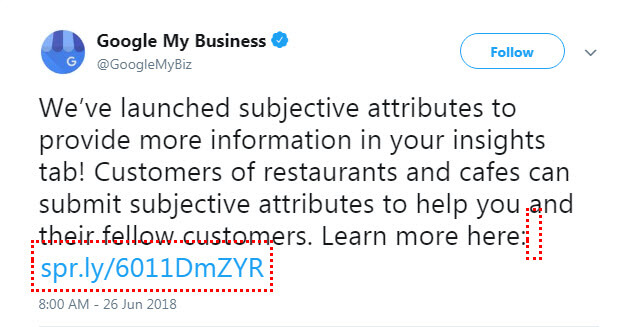
gmb-tweet-announcement.jpg

Google announced on Twitter that they’ve “launched subjective attributes to provide more information in your insights tab! Customers of restaurants and cafes can submit subjective attributes to help you and their fellow customers.”

What are Subjective and Objective Attributes in Google My Business?

Attributes in Google My Business are statements that say something about your business in very few words and help searchers decide whether your business is what they’re looking for.

All Google My Business managers have the option to add and edit objective, factual attributes in their listings information to let customers know more about what they offer. For example, a restaurant can show they accept credit cards, have a happy hour, offer late night food, or serve comfort food.

What’s the difference between Objective and Subjective Attributes? Put simply, an Objective Attribute is a business’fact’ that the listing manager/owner can control within GMB, while a Subjective Attribute is under the control of user-submitted answers on Google Maps, and is much more based on opinion.

It’s important to note, however, that searchers can also make suggestions about these Objective Attributes. When there is enough supporting input from users, then Google may “suggest” these changes in the Google My Business dashboard. As a listing manager/owner, you should monitor these suggested changes on a regular basis to ensure you business is being accurately represented.

Some real-world examples of Objective Attributes:
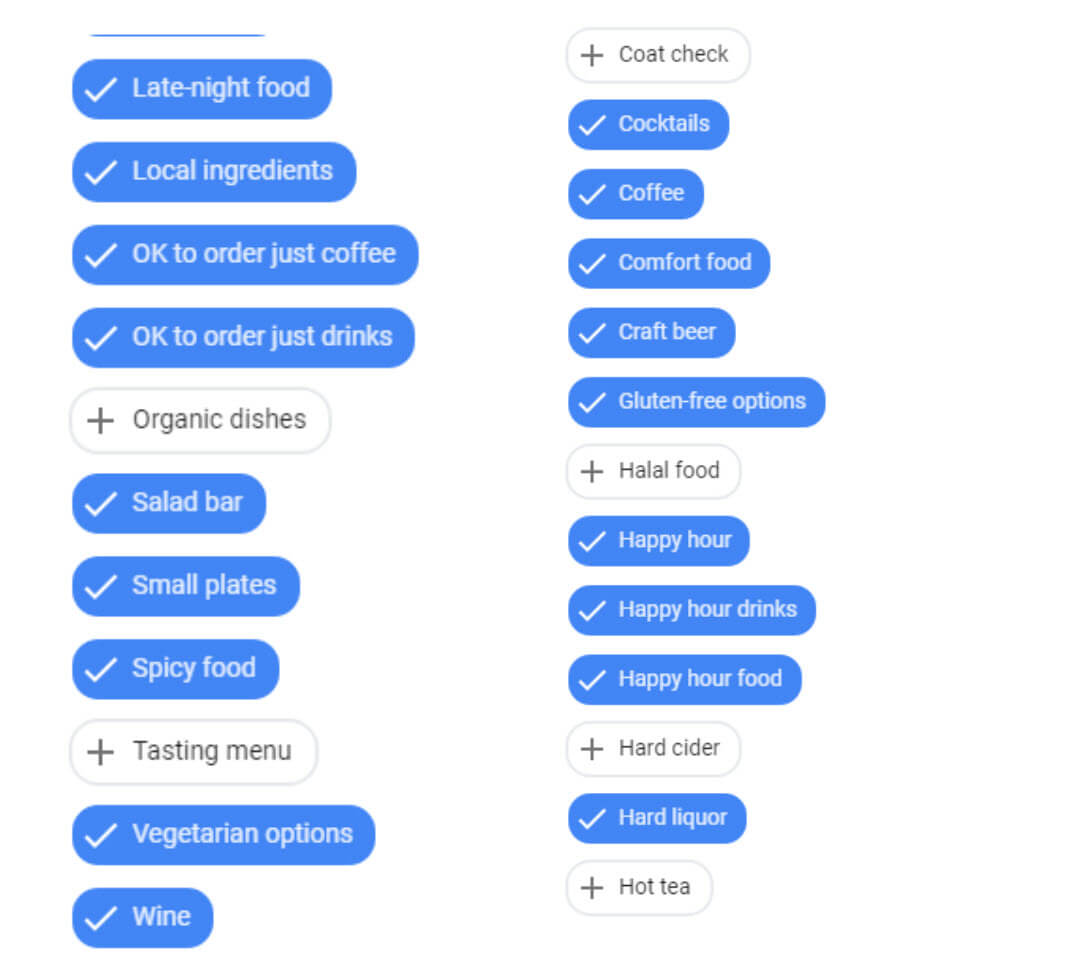
attributes-screen.jpg

Google’s guidance on adding or editing GMB attributes:
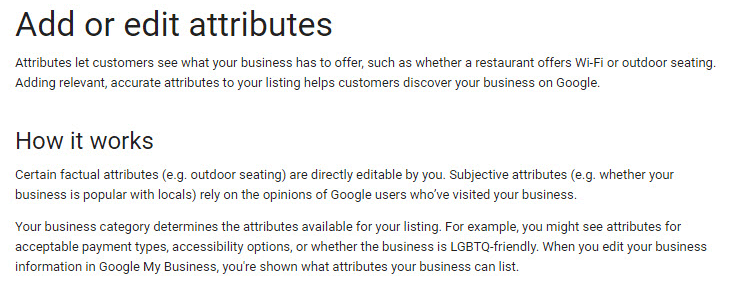
edit-attributesNEW.png

While GMB managers can edit Objective Attributes, Subjective Attributes cannot be controlled by businesses. These are things that rely on the opinions of Google users who have visited the business. If several customers say your business is “popular with locals,” for example, then this is considered a Subjective Attribute.

This is what Attributes look like in Google My Business Insights:
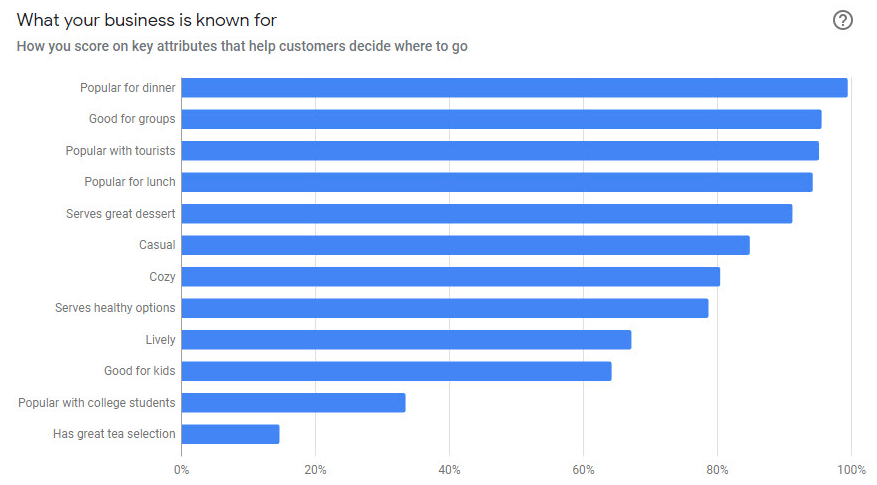
business-knownfor-screenNEW.png

gmb-help-whatknownforNEW.png

A Brief History of Google My Business Attributes

Back in May of 2016, Google added the ability for a business to control the attributes section of Google My Business. Five months later, in September of 2016, Google Top Contributor Joy Hawkins saw attributes emerge in the Google My Business dashboard.

Around the same time, Google started asking users if they “Know This Place?” on Android and iOS version of Google Maps. This was when and how Subjective Attributes started to be gathered by Google.

We know that Google is a Machine Learning-first company, but the value of human input is paramount to the dataset as the algorithm continues to learn. As is with all data provided by humans, it is subjective to the way a person feels at any given time. Therefore, Google must ask the same question (or variants of the same question) to as many users as possible to determine the right answer.

know-this-place-in-action-low-resolution.gif

Fast-forward to today, and many businesses now have the ability to edit their attributes. Some industries only have a handful of attributes while others, like hotels and restaurants, have many options.

And until now, it has been largely unknown how Subjective Attributes would be used. Only now are we getting a glimpse about how Google is using these attributes on the front end.

How reliable are GMB Insights?

As Gyi Tsakalakis pointed out in his article, GMB insights are not always as reliable as we would like them to be. All GMB stats are based on large samples of data and insights, and ‘Calls and clicks’ are not always reliable, but as with any tracking software these results can be used as a baseline for trending data.

When it comes to Subjective Attributes, since this is all based on crowdsourcing, there is a pitfall in the data gathering. As you can see in the animation above, users are initially only presented with three options per question:

Yes No Not sure

However, users can also select “More Choices”, at which point they’ll be presented with the following options:

It depends Question is unclear Haven’t been here Does not apply Place is Permanently Closed

These additional data sets are more than likely being used to train Google. If enough people state that the question is not clear, then it is logical to think that other users may see a variant of the question.

more-options-576x1024.jpg

How this can be gamed and where is the danger?

Just like fake reviews, I am sure that someone will come up with a way to try and game this system. If you could convince enough users that they have been to a certain restaurant and answer questions that are true as false, then this could potentially create inaccurate Objective Attributes that mislead the consumer. Of course, this would be maddening as they cannot be edited.

So, what can you do as an agency or a business owner?

The first thing you can do is look at what questions are being asked by Google. Catalog the questions on a regular basis and look for new ones.

The next thing you could do is edit your GMB Business Description to include the Objective Attributes you want users to highlight. You could do this with GMB Posts as well.

Another option is to take this offline. Hang up signs that tell your customers about the business. This way when they look at the questions Google is asking they will have the idea planted in their mind. You want to be known for being family-friendly, right? Why not remind them of this when they’re visiting?

I’d love to hear what you think

If you have some stories about your experience with Subjective Attributes, please share them in the comments below!

Ben Fisher is a Google My Business Top Contributor, and an experienced veteran in SEO and social since 1994. He’s the co-founder of Steady Demand which works with agencies and businesses to maximize outsourced Local SEO and Social Media. He can be reached on Twitter at @TheSocialDude or @SteadyDemand.

The post What Are GMB Insights’ Subjective Attributes and How Can You Use Them? appeared first on BrightLocal.


Read more: brightlocal.com

https://infoforu.org/what-are-gmb-insights-subjective-attributes-and-how-can-you-use-them/

Sunday, July 29, 2018

The Brutal Lifecycle of JavaScript Frameworks

JavaScript UI frameworks and libraries work in cycles. Every six months or so, a new one pops up, claiming that it has revolutionized UI development. Thousands of developers adopt it into their new projects, blog posts are written, Stack Overflow questions are asked and answered, and then a newer (and even more revolutionary) framework pops up to usurp the throne.

Using the Stack Overflow Trends tool and some of our internal traffic data, we decided to take a look at some of the more prominent UI frameworks: Angular, React, Vue.js, Backbone, Knockout, and Ember.

Framework lifecycle

Stack Overflow Trends lets us examine how each of these technologies has been asked about over time. We can start by looking at some of the larger frameworks.

trends-major.png There was a time when jQuery was the darling of JavaScript tags on Stack Overflow, accounting for almost 8% of new questions. This picture quickly changed as AngularJS and later React were released, cannibalizing jQuery’s mindshare amongst the community. Then starting around 2016, there is a quick shift from AngularJS to Angular, which represents the subsequent versions (Angular 2+), as developers began to migrate to the latest and greatest flavors of the popular framework from Google.

These larger frameworks show only part of the picture. There also were smaller frameworks vying for dominance. The picture here shows just how brutal the lifecycle can be.

trends-minor.png There appear to be two major phases in JavaScript framework usage. There appears to be a quick ascent, as the framework gains popularity and then a slightly less quick but steady decline as developers adopt newer technologies. These lifecycles only last a couple of years. Starting around 2011, there seems to be major adoption of a couple of competing frameworks: Backbone, Knockout, and Ember. Questions about these tags appear to grow until around 2013 and have been in steady decline since, at about the same time as AngularJS started growing. The latest startup is the Vue.js framework, which has shown quick adoption, as it is one of the fastest growing tags on Stack Overflow. Only time can tell how long this growth will last.

By Language or Technology

There are various factors that may go into a developer’s use of one particular front-end framework or another. Developers who primarily work with one programming language or technology may be more inclined to choose a certain UI framework. For instance, we might expect Node.JS developers to choose a different framework than ones who work with Ruby on Rails.

We can get a sense of this by breaking developers into groups based on the tag they most visit, and for each group examine the percentage of traffic that goes to each of these frameworks.

tag_percent_graph-1-675x675.png

Both TypeScript and CSS users have relatively high traffic to JavaScript frameworks across the board compared to the other technologies we examined. This makes sense as developers who work with these technologies tend to do front-end development, so they’re more likely to use a JavaScript framework. The relationship of Angular to TypeScript is particularly strong as Angular (not AngularJS) is written in TypeScript.

As a gut check, we included C and C++ in this analysis. Since developers who primarily use C and C++ tend to do more systems programming, they are less likely to use a JavaScript UI framework, and this is apparent based on the relatively low percentages across each framework.

Angular and React are by far the most popular across the board, no matter the technology used. It makes sense that they are the clear frontrunners, supported by two of the biggest and most influential companies in tech. Just looking at those two frameworks, Angular is more visited amongst C#, Java, and (to a degree) PHP developers, whereas React is more popular with Rails, Node.js, and Python developers.

There are a couple of interesting observations when we look at some of the less popular tags. Ember.js and Ruby on Rails share a disproportionately strong relationship compared to other technologies. This marriage could be due to some of the philosophical similarities between the two frameworks. Ember was created by Yehuda Katz, a member of the Ruby on Rails core team. Due to this, both Ember and Ruby on Rails advocate a convention over configuration paradigm that make these two technologies complimentary and allow developers to quickly be productive without worrying about the nitty gritty configuration, until they need to.

Unsurprisingly, Knockout.js receives disproportionately more traffic by C# developers, most likely since Knockout is also a Microsoft technology. PHP is also an interesting case. It is designed for and primarily used for web development, but PHP developers are not visiting many Angular or React questions (and not too many to JavaScript frameworks as a whole), but visit a disproportionate amount of Vue.js questions.

Industry

The choice of JavaScript framework also varies by industry, which we can segment for US traffic by matching IP address to companies. Since React and Angular are the most popular frameworks, we compared the traffic to each tag in the median organization within each industry.

What industries tended to use each of these frameworks?

tag_by_industry_graph-1-675x675.png

We can tell that the media and retail industries by far tend to use these frameworks and have a higher percentage across the board compared to other industries, as companies in these industries tend to gravitate to newer technologies to bring rich client-side experiences to their users to engage with content and refine the online shopping experience. This contrasts with the academic, government, and healthcare sectors, which appear to have little need for these types of frameworks. This may be because those industries are relatively more concerned with database management or data analysis rather than front-end web development.

The largest outlier and mystery is the insurance industry. Compared to other industries, Insurance companies as a whole seem to use Angular at very high rate, without using much React. We’re still looking further into why this would be the case, but if there are any developers who work for an insurance company reading this, feel free to leave your conjecture in the comments.

React and Angular Usage in the United States

As we have examined in previous posts, choice of programming technologies differ greatly by geography.

So, keeping with the React and Angular theme, which cities in the United States (among the 25 cities with the most visits overall) are more likely to use these frameworks?

by_us_city_graph-1-675x675.png

Interestingly enough, this group of cities is split fairly evenly between the frameworks, with Dallas and Denver trending more towards Angular and Brooklyn and San Francisco more towards React. I like to think San Francisco and Brooklyn are two of the trendiest cities in the US, and that this is why developers in those cities are also trendy with regards to their choice of framework.

Conclusion

Let me be clear, even though I’m from Brooklyn and have a budding affinity for React, I am not advocating for the use of any framework in particular. Like every technology choice, it’s not about what’s “hot,” but more about identifying tradeoffs and finding the tool for the problem at hand. But let’s be honest, the size of a developer community certainly counts; it contributes to a thriving open source environment, and makes it easier to find help on Stack Overflow.

Whichever JavaScript frameworks you use, if you’re a web developer looking to take the next step in your career, here are some currently companies hiring front-end web developers on Stack Overflow Jobs.

The post The Brutal Lifecycle of JavaScript Frameworks appeared first on Stack Overflow Blog.


Read more: stackoverflow.blog

https://infoforu.org/the-brutal-lifecycle-of-javascript-frameworks/
