Showing posts with label people. Show all posts

Monday, November 25, 2019

19 Tips to Write Catchy Email Subject Lines [+ Examples]

No matter what they say, people do judge emails by their subject lines.

In fact, 47% of marketers say they test different email subject lines to optimize their emails' performance. That's why it's so important to craft subject lines that are compelling enough to get people to click through.

While they may seem like a small part of your message, they're one of the very first impressions you have on your email recipients. And they're a marketer's ticket for standing out in a crowded inbox.

Do you want your email content opened, read, and clicked? It all starts with the subject line. Read on for some tried-and-true tips to help jazz up your subject lines and boost your emails' engagement.

Email Subject Line Best Practices

Before we get to our more detailed tips, let's go over some fundamentals of what makes a great subject line. Regardless of your goals, these are the essential elements that your subject line should possess:

1. Urgency

There's a phrase that, for many of us, is reminiscent of classic infomercials: "Act now!" And while we wouldn't encourage using that exact language in your content, we do agree that communicating urgency and scarcity in an email subject line can help compel readers to click (or act) -- when phrased creatively and strategically. But because you don't want to be known as "the brand that cried wolf," use these subject lines sparingly, and try to limit them to when the occasion genuinely calls for immediate action.

2. Curiosity

Sometimes, subject lines work because of their ability to send the message, "You will benefit from opening this email." But other times, it's good to maintain some sense of mystery -- especially if it pique's the recipient's natural curiosity and interest. Because they require opening the email to get more information, they can result in, well, a higher open rate. But make sure the subject line, while enigmatic, still aligns with your brand. Too obscure, and it could end up being seen as spam.

3. Offers

Here's where that benefit of opening a given email comes in. At the end of the day, people love new things and experiences -- especially when they come free, or at least discounted. Open with that by including it in your subject line. Personally, I'm much more inclined to open my daily newsletters when there's an offer of or allusion "free stuff" directly mentioned in my inbox.

4. Personalization

No two email subscribers are exactly the same -- and, sometimes, that means the emails you send them shouldn't be, either. At this point in time, marketers have never had more ways to learn about their subscribers' preferences, jobs, or general (dis)likes. So when you send them content, on occasion, make it catered toward the individual.

5. Relevance and Timeliness

When we subscribe to an email list, much of the time, it's because we want to be kept informed, or at least learn more about a given topic (more on that later). Similar to piquing your audience's curiosity, crafting email subject lines that incorporate trending topics or timely headlines can help you establish your brand as an authority within your industry -- and can compel people to click to read.

6. Name Recognition

Let's face it: We all have famous people who, at some point, we presently or previously have admired. And when you understand your audience's preferences and interests, you can pique their interest by including the names of this admired, recognizable individuals by including them in your content -- and mentioning them in your email subject lines. But take heed: This tactic really only works when it aligns with your brand, product, or service, so keep it relevant, rather than just throwing out a recognizable name for the sake of recognition.

7. Cool Stories

At risk of sounding like a broken record, here's another place where curiosity comes into play. By front-loading your email subject line with a compelling allusion to a story that the message tells -- but can only be read if opened or clicked -- your audience is like to become intrigued, and want to learn more. Again, make sure the story is relevant to your brand. Otherwise, it might just confuse your readers and prevent them from opening the email.

1. Keep it short and sweet.

Email subject lines will get cut off if they're too long, particularly on mobile devices. And with up to 77% of email opens taking place on mobile, we recommend using subject lines with fewer than 50 characters to make sure the people scanning your emails read the entire subject line.

If you're struggling to keep your subject lines short, think about which words matter less and where you can remove a frivolous detail. For example, if you're sending an order confirmation, doesn't “Your order is being processed” look better than “Order #9435893458358 is being processed"?

Same goes for your regular emails: Don't waste your time including the word "update" or "newsletter" in the subject line. Some studies even suggest these words can decrease the message's open rate since it tells readers the email is associated with a series, and therefore they can catch the next one.

2. Use a familiar sender name.

That name recognition we mentioned earlier doesn't just apply to the famous -- it applies to the familiar. When setting your sender name, be as human as you can. Olivia@yourcompany.com is both inviting and unintimidating to people when they open their inboxes.

If you've already met your recipients from a previous conversation, use your own name as the sender's address -- even if the email is technically coming from the company as a whole. The best impression you can make on your customers is that they're working with you, the individual -- not the entire business.

"If the 'from' name doesn't sound like it's from someone you want to hear from, it doesn't matter what the subject line is," explains Copy Hacker's Joanna Wiebe. Ultimately, people are busy, and they simply don't bother with you if you don't sound like someone who would make for an easy (or at least friendly) conversation.

3. Avoid the 'no-reply' sender name.

Thanks to the amount of spam email people get these days, most people hesitate to open email from unfamiliar senders. And even fewer people like talking to a robot. Think about when you call a company and can't get a hold of an actual person. It's frustrating, right? This goes for email, as well.

Never use "noreply@company.com." I repeat: Never use this email address. Not only does it make it look less personable, but it also stops people from adding your email to their address book.

Instead, avoid using a generic email address and send the email from a real person. For instance, we once found that emails sent from "Maggie Georgieva, HubSpot" performed better in terms of opens and clickthrough rate than emails sent from just "HubSpot." (HubSpot customers: Learn how to personalize the "From" name and email address here.)

4. Use personalization tokens.

Remember the personalization we mentioned earlier? Using personalization tokens -- like name or location -- in the subject line adds a feeling of rapport, especially when it's a name. Everyone loves the sound of their own name. Plus, it increases clickthrough rate: In fact, research has shown that emails that included the first name of the recipient in their subject line had higher click-through rates than emails that did not.

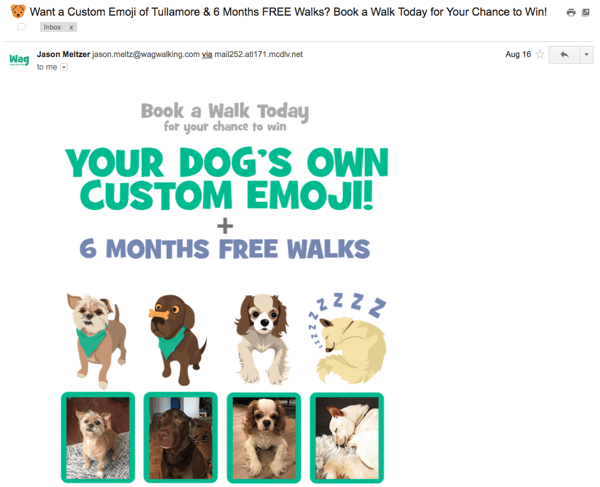
One example of how brands affix this information to subject lines is when dog walking company Wag! does so with dog names. Here's one such email that HubSpot's Amanda Zantal-Wiener received:
Screen%20Shot%202017-10-03%20at%202.25.15%20PM.png?width=600&name=Screen%20Shot%202017-10-03%20at%202.25.15%20PM.png

That's great personalization and great timing.

Another personalization tactic that works is to tailor subject lines to the recipient's location -- things like lists of their respective cities' best outdoor bars and restaurants.

Just don't go overboard with the personalization here. That can be a little creepy. But little personalized touches here and there show that you know more about your recipients than just their email address. However, if you can't (or don't want to) use personalization tokens in the subject line, use "you" or "your" so it still sounds like you're addressing them directly.

5. Segment your lists.

While email blasts that go out to your entire list might be relevant and helpful to some people, it won't be to others -- and could cause confusion or frustration. Why is this restaurant sending me a list of the best local steakhouses when I'm a vegetarian? Why is this company sending me case studies when I just signed up for its email list yesterday?

Personalize the experience using information from the actions your customers have already taken -- from which forms they've filled out, to which industries they're in, to what their personal preferences are. In email marketing, you can personalize your recipients' experience using a little thing called list segmentation.

How you segment your lists depends on your business and your goals, but you can read this blog post for 27 ideas for how to slice and dice your email lists for better segmentation.

6. Don't make false promises.

Your email subject line is making a promise to your reader about what you will deliver in your message. Make sure that you make good on that commitment -- and do not try to get your email opened by making false promises. This will irk your audience, and they'll learn not to trust your subject lines, resulting in a lower open rate and a higher unsubscribe rate.

7. Do tell them what's inside.

Speaking of making promises, if your visitor has downloaded an offer and you're delivering it via email, it's a great idea to use a subject line that says something like, “Your new ebook inside!” or, “Your guide awaits!” This works better than a simple “thank you” in the subject line because it makes it clear that something is waiting inside the email.

8. Time it right.

Sending an email at the right time with the right subject line can make a huge difference in open and clickthrough rate. A prime example? When food publication Eater sends at 6:45 P.M. on a Wednesday evening that said, "Where to Drink Beer Right Now" -- just in time for happy hour. Nailed it.

Another favorite example of mine is a classic email from Warby Parker with the subject line, "Uh-oh, your prescription is expiring." It was sent two weeks before the recipient needed to renew his prescription. By sending an email at the right time, Warby Parker increased the chances of their email getting opened -- and included a relevant call-to-action about getting a glasses upgrade, too.

9. Use concise language.

Keep in mind that people scan their inboxes very quickly -- so the more clear and concise your subject line is, the better. It's usually a lot better to be concise than it is to use complex and flowery language -- unless you're going for an elusive subject tone to entice your recipients.

When you're going for a concise subject line, think first about how your email will benefit your recipients. You'll want to make that benefit very clear. For example, "Increase your open rates by 50% today” is more appealing than "How to increase open rates."

10. Start with action-oriented verbs.

Subject lines are similar to calls-to-action, in that you want the language to inspire people to click. Subject lines that begin with action verbs tend to be a lot more enticing, and your emails could be drastically more clickable by adding a vibrant verb at the beginning.

Actionable subject lines will inspire people to click on your email by instilling urgency and excitement. For example, in an email inviting people to a hockey legend dinner, the email subject line might read, “Dine with Bruins legend Bobby Orr,” rather than a more generic (and less actionable) “Local Boston Sports Legend Meal." The former email uses “Dine” to help the reader envision themselves at a dinner table.

11. Make people feel special.

The psychology of exclusivity is a powerful thing. When people feel like they're on the inside, it gives them a sense of belonging that could build loyalty and compel them to convert better on your emails.

The right phrasing can make your recipients feel special -- and the effect can be magical. A few ideas for phrasing include:

"For our beloved customers only" "An exclusive offer for you" "My gift to you" "You're invited!" "Private invite" 12. Create a sense of importance.

There's a phrase that, for many of us, is reminiscent of classic infomercials: "Act now!"

And while we wouldn't encourage using that exact language in your content, we do agree that communicating urgency and scarcity in an email subject line can help compel readers to click (or act) -- when phrased creatively and strategically.

But because you don't want to be known as "the brand that cried wolf," use these subject lines sparingly, and try to limit them to when the occasion genuinely calls for immediate action.

13. Use numbers.

A lot of businesses send emails with vague statements in their subject lines -- which is why using data and numbers is a great way to get your emails noticed, demonstrate a clear and straightforward message about your offer, and set the right expectations.

Just like with blog titles, using numbers in your subject line is an effective email marketing best practice. You might use numbers to refer to the title of your listicle, the page length of the offer you're sending, a specific discount, or the numerical benefit of a particular resource you're providing -- like "Join more than 750 others at this event!"

14. Pose a compelling question.

Asking a question in your subject line can also draw readers in -- especially if you're asking a question you know is relevant to your recipients' buyer persona. This is just one way to pique that curiosity we mentioned earlier. For example, you might try the following: “Are you making these SEO mistakes?” or “Do you know what your website is doing wrong?"

Zillow once sent an email with the subject line, "What Can You Afford?" that linked to a website showing apartments for rent. A subject line like this is both encouraging and a touch competitive: While it gives hope that there are apartments out there that'll fit within your budget, it also pits your cash against what the market offers.

Another example comes from DocuSign. They sent an email late in the lead nurturing process, with the subject line, "What are your customers saying?" The body of the email contained a bunch of case studies that were meant to help the recipient move closer to actually purchasing DocuSign. This was a smart move: Folks who are further down the funnel are likely more receptive to hearing customer testimonials.

15. Don't be afraid to get punny.

Most people love a good pun. It's a great way to delight your recipients and spice up your emails. Some of the best punny email subject lines come from JetBlue, with subject lines like "Land wander-

Some of the best punny email subject lines come from JetBlue, with subject lines like, "Land wander-ful low fares now!"

Quirky -- a community-led invention platform -- worded one of its email subject lines like this: "Abra-cord-abra! Yeah, we said it." That second part is conversational and self-referential -- and exactly what most people would say after making a really cheesy joke in real life.

If you're the least bit punny, think about small ways you can slip them into your emails when it's appropriate. Just don't overdo it. And remember the rule: When in doubt, ask a coworker.

16. DON'T USE ALL CAPS or overuse exclamation points!!!

A subject line that says, “OPEN NOW AND RECEIVE A FREE TRIAL” or, "50% off coupon today only!!!!!!!!" isn't going to get your email opened. In fact, it'll probably get your email ignored.

Why? People don't like to be yelled at, and using all caps and/or a lot of exclamation points can really rub people the wrong way. In fact, according to a study by the Radicati Group, more than 85% of respondents prefer an all-lowercase subject line to one in all caps.

Not only are these tactics disruptive, but they look spammy. So instead of using disruptive tactics like these to stand out in people's inboxes, try personalizing your emails, establishing relevancy, and using catchy and delightful language.

17. Don't include a question and exclamation in the same subject line.

Here's a subject line that can automatically wind up in a recipient's spam folder: "Want a solution fast? Act now!"

The fast solution isn't the problem the example above. It's also not “act now” — although those are known email marketing spam words. It's both phrases together. This is a classic email saboteur, and it comes in many forms. All you need is to ask and yell at the same time.

The PLING_QUERY rule is a directive by the Apache web server that flags an email as spam if it contains both a question mark and an exclamation mark in the subject line. The example above is a common one. A good solution? Don't do that!

Not only is this subject line format overdone, but it's alienating to your audience. Open-ended questions are a show of ignorance; any good marketer knows their leads better than that.

18. Use engaging preview text.

While preview text isn't technically part of your subject line, it does appear right near the subject line -- and it certainly deserves your attention.

Preview text provides recipients with a peek at the content inside your email, which email clients like the iPhone Mail app, Gmail, and Outlook will display alongside the subject line. (The exact amount of text shown depends on the email client and user settings.)

email-preview-text-in-inbox.png?width=730&height=57&name=email-preview-text-in-inbox.png

When you don't set the preview text yourself, the email client will automatically pull from the body of your email. That can look messy depending on your email content, and it's also a wasted opportunity to engage your audience. (HubSpot customers: Click here to learn how to set the preview text of your emails.)

19. A/B test your subject lines.

Although these tips and best practices are a great place to start, what works best for some companies may not work as well for others. It's all about figuring out what works best for your specific audience. That's where A/B testing comes in.

While it can be tempting to use your intuition to predict what subject line language will make people click on your emails, you should always A/B test your highest-stakes subject lines, and tweak the wording according to your results. What works best for your audience: Long or short subject lines? Including numbers or not including numbers? Questions or statements?

Read this blog post for an A/B testing checklist you can bookmark the next time you want to run one on your emails. (HubSpot customers: Learn how to A/B test emails in HubSpot here.)

Examples of Catchy Email Subject Lines

To give you some added inspiration, here's a quick list of some of the most intriguing subject lines we've seen recently.

"Claim your UNLIMITED free photo book + pages and more" - Shutterfly "👻Trip or treat! Up to $300 off ends tomorrow" - EF Tours "Generous PTO and summer Fridays" - Mediabistro Subject: "It's scary outside." Preview text: "Here's $5 to stay in" - Drizly "Smoldering red lipstick" - Chanel "Corelle. (Enough said.)" - Wayfair "Do you know how important this is?" - Allstate "Electrify your next night out. Trending party dresses are now on sale." - Wish

At the end of the day, if your emails aren't getting opened, they're not getting seen. You have great content to share -- now, you have to prove it in your subject line.

Editor's Note: This blog post was originally published in July 2018 but was updated in November of 2019 for comprehensiveness.

__ptq.gif?a=53&k=14&r=https%3A%2F%2Fblog.hubspot.com%2Fmarketing%2Fimprove-your-email-subject-line&bu=https%253A%252F%252Fblog.hubspot.com%252Fmarketing&bvt=rss

Read more: blog.hubspot.com

https://infoforu.org/19-tips-to-write-catchy-email-subject-lines-examples/

Monday, July 29, 2019

14 of the Best Public Relations Examples to Inspire Your Next Campaign

Sometimes, a press release about your company’s new product launch, significant hire, or acquisition fails to pick up the coverage you were expecting. Journalists crave juicy stories and viral marketing campaigns, but standing out in a sea of conventional pitches is one of the biggest challenges for any public relations professional.

When you need a dose of inspiration, blogs like PR Examples are a great place to find the most compelling PR plays. To save you some time, we curated a list of the absolute best of the best to get the creativity flowing for your next campaign.

Read on to get inspired by some of the best minds in public relations.

1. Lyft & Netflix: Strange Mode  Industry Relations

With over 360,000 people who binge watched Stranger Things 2 within a day of its release, it’s clear the show created unprecedented amounts of hype leading up to its premiere date. One of the stunts that built up this hype was Lyft and Netflix’s Strange Mode prank. By immersing Lyft customers in an environment that was as terrifyingly strange and eerily similar to Hawkins, Indiana, they made Stomranger Things fans feel like they were actually in the Upside Down.

2. HostelWorld: Even Divas are Believers Customer Relations

Traveling the world can give you some of the best experiences of your life, but it can also thrust you into situations that you’ll want to scrub from your memory, like staying the night in a hostel. There are countless hostel horror stories online and hundreds of videos that mock their hospitality scattered throughout social media -- so needless to say, they don’t have the best reputation.

But HostelWorld, a hostel booking website, decided to team up with Mariah Carey to freshen up their image and showcase the pleasant reality of staying in a modern day hostel. Together, they blasted through affordable accommodation stereotypes by spotlighting the lesser known luxuries of hostels like having access to the same facilities as more expensive accommodations, but at a cheaper price, and being able to connect with other fellow travelers.

HostelWorld’s message is simple: if hostels are nice enough for divas like Mariah Carey, then they’re nice enough for everyone..

3. Lawyer.com: Choosing Lindsay Lohan to Be their Spokesperson Customer Relations

Picking Lindsay Lohan to be your company’s official spokesperson could spark a lot of backlash. But when you connect people with lawyers, the move can produce loads of smiles, publicity, and customers. Lawyer.com’s brilliant marketing play resonated with audiences because Lohan’s troubled past and her frequent brushes with the law makes people who might’ve gotten in a little trouble feel like they’re not alone. It also makes them feel better about themselves. If a high-status celebrity needed a lawyer -- multiple times -- then maybe it’s not so bad if you need one too -- right?

4. Stabilo Boss: Highlight the Remarkable Corporate and Social Responsibility

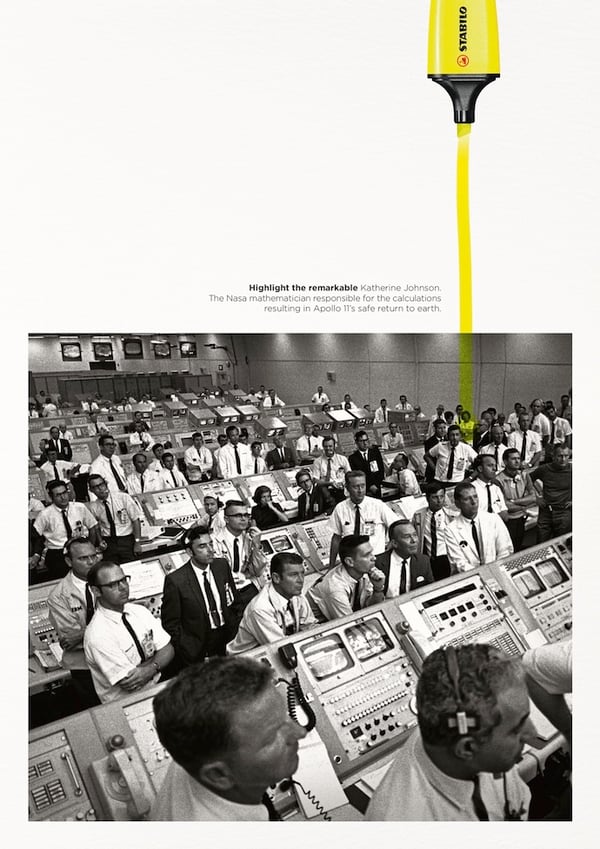
There have been remarkable women throughout history that might not have been celebrated as they should have been. Stabilo Boss -- the company that sells highlighter pens -- started a campaign to highlight these women and their incredible accomplishments. 

Stabilo took famous black-and-white photos from historical moments and drew a yellow highlight line to showcase the woman in the photo that made it all happen. The Boss PR campaign highlighted women like Katharine Johnson, the NASA mathematician responsible for the calculations that sent Apollo 11 to the moon. Other examples include Nobel Prize winner Lise Meitner ando First Lady Edith Wilson.

The campaign blew up on social media and went on to win multiple awards.

stabilo_boss_katherine_print_thumb.jpg?width=600&name=stabilo_boss_katherine_print_thumb.jpgPhoto credit: Ads of the World 5. Logitech: BS Detection Spoof Industry Relations

Hours after April Fools Day, almost every marketing publication rounds up the best spoofs, pranks, and stunts that distracted everyone at work that day. One of the funniest spoofs that earned a spot in all the major roundups this year was Logitech’s fake Business Speak Detection product video. By giving their product a punny, yet subtly accurate name, the video pokes fun at most businesses’ obsession and overuse of buzzwords. But it also has the feel of a real product overview, which makes it even more hilarious.

6. Old Spice: Paper Blazer Ad Marketing Communications 10%20of%20the%20Best%20Public%20Relations%20Examples%20to%20Inspire%20Your%20Next%20Campaign-1.png?width=600&name=10%20of%20the%20Best%20Public%20Relations%20Examples%20to%20Inspire%20Your%20Next%20Campaign-1.png

Photo Credit: PR Examples

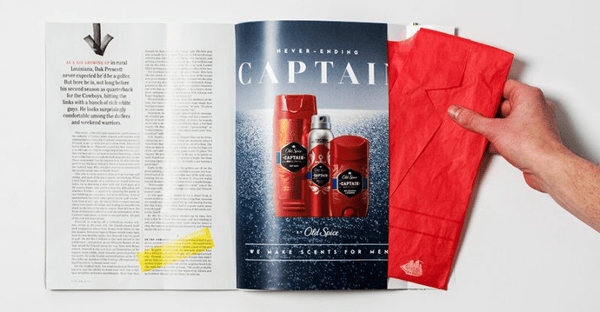
When Fragrance brands advertise in magazines, they usually show off their aromas by drenching an ad with their latest cologne or perfume. But Old Spice realized people usually don’t enjoy unexpectedly pungent scents violating their nostrils when they’re flipping through their favorite magazine. So in typical Old Spice fashion, they gently ribbed other fragrance brands by inserting a paper blazer doused in their new cologne, Captain, in their print ad in GQ magazine. Then they wrote about how these paper blazers can help men attract attention not only with trendy style, but also with masculine smell. The only drawback of the blazer is that it'll turn into papier-mâché on you in the rain.

Humor and cleverness is one of the best ways to appeal to your audience and gain earned media attention, and it seems like Old Spice can leverage them both on any marketing channel.

10%20of%20the%20Best%20Public%20Relations%20Examples%20to%20Inspire%20Your%20Next%20Campaign-3.png?width=600&name=10%20of%20the%20Best%20Public%20Relations%20Examples%20to%20Inspire%20Your%20Next%20Campaign-3.png

Photo Credit: PR Examples

7. Star Wars: Passing the Box-Office Baton to The Avengers Social Media

Congratulations, @MarvelStudios and @Avengers: #InfinityWar. pic.twitter.com/PnHfaouOlP

— Star Wars (@starwars) May 1, 2018

Avengers: Infinity War just shattered Star Wars: The Force Awakens’ record for the biggest opening weekend ever by grossing over $250 million. LucasFilm, the studio that created and produced Star Wars, wasn’t bitter though. Instead, they were proud of their friends over at Marvel Studios, and sent them a heartwarming congratulatory tweet. By applauding them for their incredible accomplishment, and not sulking about their broken record, Star Wars earned the respect of movie lovers everywhere -- not to mention some media coverage for the gesture.

8. Johnnie Walker: Jane Walker Corporate and Social Responsibility


10%20of%20the%20Best%20Public%20Relations%20Examples%20to%20Inspire%20Your%20Next%20Campaign-2.png?width=600&name=10%20of%20the%20Best%20Public%20Relations%20Examples%20to%20Inspire%20Your%20Next%20Campaign-2.png

 Photo Credit: PR Examples

To promote gender equality and honor the many achievements of women throughout history, Johnnie Walker launched a female version of its whisky on International Women’s Day called Jane Walker. The limited-edition bottle featured a woman on their iconic logo, instead of a man, which connected the brand to individuals who also support their commitment to social progress.

In March 2018, Johnnie Walker released 250,000 bottles of Jane Walker, and for every bottle sold, they donated $1 to organizations that empower women. This tangible impact helped their campaign gain even more support and publicity.

9. AirBnB & BBC Earth: Night at Blue Planet II Industry Relations

Blue Planet II is considered the greatest nature series of all time, with its first episode attracting over 14 million viewers and earning the title of Britain’s highest rated TV show in 2017. Watching the show can almost place you into the habitat they’re filming, but BBC Earth wanted to take things to the next level for their biggest fans: they offered them a chance to experience what it’s like to be a researcher and filmmaker for Blue Planet II.

To do so, they teamed up with AirBnB to run a contest for their members, and two lucky winners got to spend three days and two nights in the Bahamas on the research and exploration vessel used in the show’s filming. During their expedition, they lived with and discussed work with researchers and dove deep into the Atlantic Ocean in a submarine with filmmakers to observe some of nature’s most unique underwater wildlife. By offering a once in a lifetime opportunity, BBC Earth could get more people to watch their hit show, and AirBnB could build their brand affinity.

10%20of%20the%20Best%20Public%20Relations%20Examples%20to%20Inspire%20Your%20Next%20Campaign.png?width=600&name=10%20of%20the%20Best%20Public%20Relations%20Examples%20to%20Inspire%20Your%20Next%20Campaign.png

Photo Credit: PR Examples

10. SpaceX & Tesla: SpaceX Sends a Tesla into Outer Space Public Affairs

View from SpaceX Launch Control. Apparently, there is a car in orbit around Earth. pic.twitter.com/QljN2VnL1O

— Elon Musk (@elonmusk) February 6, 2018

Everyone knows Elon Musk wants to send humans to Mars. So when SpaceX launched their newest rocket, Falcon Heavy, into space, it made some headlines. But when the Falcon Heavy suddenly shot a cherry-red Tesla Roadster blasting David Bowie’s 1971 hit “Life on Mars?” into orbit, it was being called the greatest automotive PR stunt in history.

The car will now float between Earth and Mars for millions of years, and serve as reminder for current and future generations to always reach for the stars. The success of both launches also improved SpaceX and Falcon Heavy’s reputation. Falcon Heavy is now the most powerful rocket on earth, so it’s realistic to say it can launch heavy satellites and future space stations into orbit, shuttle cargo to Mars, and even transport humans to the moon. And that’s exactly what Elon Musk needs the public to think if he wants to accomplish his ambitious goals.

11. BBC Scotland: Scotland From the Sky: Glen Coe Integrated Marketing and Communications

In 2017, Rough Guides, a renowned travel guidebook, named Scotland the most beautiful country in the world. And a big reason why it’s such a spectacle is because Glen Coe, a Scottish valley that cuts through the ruins of an ancient super-volcano, is one of the most striking landscapes in the world.

BBC Scotland’s immersive, 360 degree video of Glen Coe grips viewers because they’re able able to experience the landscape from an intimate point of view at every possible angle, which makes them feel like they’re actually there. Publicity of this video benefits both Scotland’s tourist industry and BBC Scotland because it compels people to travel to Scotland and consume more of BBC Scotland’s content.

12. State Street Global Advisors: Fearless Girl Corporate and Social Responsibility

On the morning of International Women's Day, the world woke up to find a four-foot high statue of a girl across from the Charging Bull statue on Wall Street in New York. She is standing tall and brave, hands on her hips, in a dress and high top converse. 

Fearless Girl, as she is called, was commissioned by the investment management firm State Street Global Advisors as a part of their campaign to pressure companies to add more women to their boards. By standing up to Charging Bull, she is standing up for gender diversity on Wall Street. 

fearless-girl-PR-campaign-example.jpg?width=600&name=fearless-girl-PR-campaign-example.jpgSource: Forbes

Some argue that the girl's defiance toward the bull -- and male-dominated corporate boardrooms more generally -- is controversial. There has been lots of pushback to the statue, but in general, this PR campaign received widespread support for the women's movement and diversity in the workplace and remains outside the New York Stock Exchange.

13. ALS Association: ALS Ice Bucket Challenge Corporate and Social Responsibility

A few years ago, videos of people dumping a bucket of ice water over their heads flooded social media, now known as the Ice Bucket Challenge. The viral sensation of 2.4 million videos was a way to raise awareness of a neurodegenerative disease called amyotrophic lateral sclerosis -- also known as ALS or Lou Gehrig's disease. The idea was to raise money for the ALS Association and research on the disease. 


The viral challenged raised more than $115 million dollars, with almost $80 million going towards research. The campaign was a massive success -- awareness and funding for ALS has skyrocketed, all thanks to millions of people giving themselves brain freeze.

14. Guinness: Guinness Clear Corporate and Social Responsibility

Guinness pushed a series of ads to promote its newest product: Guinness Clear. This completely transparent, refreshing beverage "will keep you hydrated and help you stay in control." Their secret recipe? It's just water.

This lighthearted PR campaign is actually trying to address a more serious issue -- binge drinking. The company hopes that consumers will drink more of their "Guinness Clear" to remember their nights and not overdo it while still having fun. Guinness hopes the ads will drive conversation and healthier habits.


  __ptq.gif?a=53&k=14&r=https%3A%2F%2Fblog.hubspot.com%2Fmarketing%2Fpublic-relations-examples&bu=https%253A%252F%252Fblog.hubspot.com%252Fmarketing&bvt=rss

Read more: blog.hubspot.com

https://infoforu.org/14-of-the-best-public-relations-examples-to-inspire-your-next-campaign/

Saturday, July 27, 2019

Why Micro-Influencers May Be the Most Effective Influencer Marketing Strategy

They say bigger is better … but in the case of influencer strategy, we think the opposite could be true.

The latest data shows that micro-influencers, influencers with 10,000 or fewer followers, are getting the best results for brands and businesses. More engagement, more clicks, and lower ROI.

Keep reading as we dive into the world of micro-influencers and explain the ins and outs of this new trend toward going small with your influencer campaigns. If you’re keen to dip your toe into influencer marketing or if you’re just interested in a strategy shakeup, then we think you’ll find a lot to love in this post!

Understanding influencer marketing and micro-influencers

Influencer marketing has been on the rise for years now. Today, you see influencer marketing as a core strategy of direct-to-consumer brands, of e-commerce shops — even B2B companies are getting into the game. 

The premise is simple: Find someone with an audience who’s willing to share the love about your product. 

There are a lot of similarities to celebrity endorsements and to word-of-mouth marketing. Just like with those strategies, influencer marketing aims to make a brand more relatable and trustworthy in the market, especially with younger demographics. In fact, studies show that 70% of millennial consumers are influenced by the recommendations of their peers in buying decisions.

The social networks themselves are keen on influencer marketing, too. Just recently, we’ve seen Instagram, for instance, launch features around branded content and ads — features that make it easier for Creators and brands to work together. 

But like with anything popular on social media, there comes the risk of over-saturation. 

Have we reached that point with influencer marketing? 

We think the landscape has changed, certainly — and we’ll share some numbers on this in a second — but overall, we still believe that influencer marketing is a strong option for increasing your social media exposure, driving traffic to your site, and selling more. 

In fact, we believe that micro influencers are opening up influencer marketing to a whole new level.

Put simply, micro influencers are those with smaller audiences. We’re talking audience sizes of 10,000 rather than 100,000. 

These might not be the folks you think of first when you think of influencers. But it’s well worth your attention. At the micro level, there’s stronger engagement, better costs, and tons of opportunities. 

The state of influencer marketing

We’ve had a lot of new stats to pore over in recent weeks. And depending on where you look and what you read, you might end up with very different perspectives on influencer marketing. Some people think it’s reached its peak. Others think it’s still an extremely viable option.

First, the doubters.

Data from analytics firm InfluencerDB shows that influencer engagement on Instagram is at an all-time low. The engagement rate on sponsored posts is half of what it was three years ago, falling from 4% to 2.4%. 

This is true of almost all categories of social content, even the much-loved travel category. Engagement with travel influencers fell to 4.5 percent this year from a high of 8 percent just a year ago. 

Like most things in marketing, there comes a point of diminishing returns. When a feed is full of sponsored posts and branded content, you can expect that fewer people will be tapping, liking, and buying. 

But there’s also the perspective that influencer marketing is doing just fine thanks.

In a pair of recent studies — one by the PR firm Edelman and one by the social media marketing group HelloSociety — there’s been a very rosy picture of how influencer marketing is doing. 

According to Edelman, the power of influencer marketing isn’t just about engagement. Influencer marketing is how people find products and buy products — 58 percent of people have actually purchased a product because of an influencer recommendation, in just the past six months.

And influencers also shine when it comes to follower metrics and network effects. In HelloSociety’s study, survey respondents were more than three times as likely to follow an influencer rather than follow a brand. 

So what we’re seeing is that the influencer marketing landscape is changing. 

And opportunities still abound. 

Remember the stats we shared about influencer engagement just a moment ago? Engagement rates have fallen by nearly half. Well, there’s a fascinating followup to that stat, and it really shows the potential of micro influencers. 

In the same study, we saw that engagement gets better with the less followers you have.

Really!

Influencers with 10,000 followers or more have just 3.6 percent engagement.Influencers with 5,000 to 10,000 followers have 6.3 percent engagement.And influencers with 1,000 to 5,000 followers have the highest engagement at an 8.8 percent engagement rate.

This can be a game changer for brands. Think of all the possibilities this opens up!

The niche of micro influencers isn’t just a subset of the larger influencer marketing trend. It’s the most successful subset out there. It goes much deeper than just these engagement stats, too. We put together a short list of other benefits for micro-influencer marketing. 

Benefits of micro-influencer marketing 1. Micro-influencers open up a huge pool of possible influencers for your brand.

According to a report by Mention, 15.7% of Instagram users have between 1,000 and 10,000 followers, which is right in the niche of micro influencers. If you apply that percentage to Instagram’s one billion user count, that means there are 157 million micro-influencers to choose from. Wow!And you can expect to find these micro-influencers in just about any category imagineable. We mentioned earlier that influencer marketing has expanded into places like B2B and non-traditional sales. No matter what you sell — whether it’s business software or random goods and services — there’s likely to be a micro influencer or dozens of micro influencers for you to choose from.

2. Micro-influencers are perceived as “people like me.“

Often times, the traditional influencer with hundreds of thousands of followers can be more like a celebrity than a friend. With micro-influencers, this isn’t the case. These are people who are much more relatable and at peer levels with consumers. Take this stat from the Trust Baromter survey. The survey asked why people followed and trusted influencers. Relatability was nearly twice as important as popularity. Plus, survey respondents rated the credibility of different groups on social media and the “people like me” category gained the most trust in the past year. 61 percent of people find information from “people like me” to be credible.

3. Their engagement is real

An influencer survey by Hit Search found that not all followers for influencers may be real. 98% of survey respondents said they saw some iffy behavior on the follower counts of influencers. This is to be expected to a certain degree — bots can target successful accounts, and the scale of influencers is likely to attract all kinds of people, real and otherwise. At the same time, there’s likely to be very little problem with fake followers for micro influencers. You can know that the followers you’re targeting are real people and the engagement is authentic.

Ok, we’ve set the scene with lots of great reasons to give micro influencers a try. Now let’s talk about how to create a micro influencer strategy of your own.

Micro-influencer strategy tips

A lot of the strategy for micro influencers is similar to that of influencer marketing overall. We talked lots about influencer marketing in a podcast episode last fall — we’ll link to it in the show notes — so we’ll pull some tips from there plus add some new ideas about micro influencer specifically. 

1. Where to find influencers

There are really 4 places to find influencers for your brand. Google, databases, networks, and marketplaces.

Google is a manual process of typing keywords, scanning webpages for contact info, and then keeping track of the info in spreadsheets. I would also lump social media into here – manually searching social channels and hashtags for relevant influencers for a given topic.Databases do website scraping for you, pulling publicly available data. These are good places to start but you’ll need to vet the influencers yourselves, similar to what you would do with a Google or social search. In the middle of Google/social and databases are networks, which work like an agency that has relationships with the influencers, but will require that you go through them to reach out.And lastly are marketplaces. A marketplace often pulls in real-time information about influencer performance and also does a good job collecting a batch of trending influencers and making collaboration and connection easy. 

For micro influencers, we feel that the Google and social route is going to be best for finding influencers with smaller followings. A lot of them may not be in the databases and marketplaces yet.If you have a hashtag search on social for the keywords you’re targeting, it should reveal some good options of micro influencers who are talking about those terms.

2. Be conscious of the numbers that you track

As we mentioned earlier when it comes to stats, there is more than just engagement to determine a successful influencer campaign.That being said, engagement for micro influencers is one of the key draws.Monica Jungbeck, a global marketing manager at the brand Malibu, shared this interesting insight with Digiday. She said:

“For a global influencer with around 200 million followers, we don’t expect the engagement rate to be more than 5%, whereas for smaller influencers we expect that rate to double.”

Setting a 10 percent engagement rate is a good place to start then.D: You can also go deeper on measuring the ROI by tracking direct sales from the campaign from custom URLs and by using UTM parameters. Another way to measure ROI is to calculate the amount you typically pay for reach and conversion through social advertising and then apply those numbers to the reach and conversion you get from your micro-influencer campaign. For instance, if you typically pay $50 to reach 1,000 hyper-targeted people, then if your micro-influencer campaign reaches 2,000 people, it was worth at least $100 to you … and ideally you would have spent less to make the campaign happen.

3. Think outside the box when it comes to compensation. 

Great influencers will naturally want to be compensated, but the good news is that it doesn’t always have to be financially if you’re on a tight budget. This is especially true of micro influencers. They’re less likely to come with big price tags like the big-time influencers do.You can offer the influencer shout outs on your blog, website, or newsletter.You can give them your product or products for free. I’ve seen some brands offer influencers a free supply of their product for a year in exchange for a certain amount of content.And of course you can also offer influencers, like in a referral program, a certain amount of commission for every 1,000 people reached, or sale, or whatever your goal is.Quora has a great thread regrading how much influencer marketing typically costs based on influence and the type of campaign. We’ll link to it in the show notes.

4. Optimize your micro-influencers for Expertise, Authority, and Trustworthiness.

An easy way to remember this is the acronym EAT. It’s the same acronym used by Google to optimize its search algorithm.These are qualities that your audience cares about. Trust, especially, is one that really resonates with people today. Nearly two out of every three consumers say that they trust influencer messages about a brand more than a company’s advertising about their own brand. If you can judge your potential influencers according to these parameters, then your campaign is going to be in a great place.

How to say hello to us

We would all love to say hello to you on social media – especially Twitter!

Heather-Mae on TwitterDave on Twitter

Thanks for listening! Feel free to connect with our team at Buffer on Twitter, Buffer on Facebook, our Podcast homepage, or with the hashtag #bufferpodcast.

Enjoy the show? It’d mean the world to us if you’d be up for giving us a rating and review on iTunes! About The Science of Social Media podcast

The Science of Social Media is your weekly sandbox for social media stories, insights, experimentation, and inspiration. Every Monday (and sometimes more) we share the most cutting-edge social media marketing tactics from brands and influencers in every industry. If you’re a social media team of one, business owner, marketer, or someone simply interested in social media marketing, you’re sure to find something useful in each and every episode.  It’s our hope that you’ll join our 27,000+ weekly iTunes listeners and rock your social media channels as a result!

The Science of Social Media is proudly made by the Buffer team. Feel free to get in touch with us for any thoughts, ideas, or feedback.

BhR8udgsfWwAks2BwLNpuI6_NYrs9qOE4out65ktfeGU

Read more: feedproxy.google.com

https://infoforu.org/why-micro-influencers-may-be-the-most-effective-influencer-marketing-strategy/

Tuesday, May 21, 2019

15 Ways to Get More Followers on Instagram

It's no secret that business opportunities are quickly growing on Instagram. Approximately 80% of Instagram's 1 billion active monthly users now follow a business account on the platform. While Instagram hasn't reported its current number of business users, the platform reportedly hosted more than 25 million of these accounts in late 2017.

As the platform continues to grow and develop more interactive features, such as Instagram Stories, businesses are regularly using it as a tool to humanize brands, recruit future employees, showcase products and company culture, delight customers, and generate new business.

But here's the deal: Unless you're famous, it's really hard to amass a huge following on Instagram without some hard work.

For the average person or business, growing your following takes time and attention on a daily basis.55f44553-d63a-43bd-8957-63ac11fbcdb3.pngLuckily, there are a few things you can do right away to collect at least 1,000 quality followers for your personal or professional Instagram account. It's all about knowing where to invest your time and effort. Let's discuss a few strategies that will help you gain those followers, from creating a follow-worthy Instagram profile, to using contests, to staying true to your brand.

1. Create and optimize your profile.

First things first: customize your Instagram profile to make it look good, tell your potential followers who you are, and give them a reason to follow you.

How? Start by making sure your username is recognizable and easily searchable — like your business name. If your business name is already taken, try keeping your business name as the first part of your username so that people searching for your business are more likely to come across you. For example, the Australian activewear line Lorna Jane uses the username @lornajaneactive.

Setting Up Your Account

Step 1. Make sure to add your full business name to the “Name” field in the "Options" section. To find "Options," tap the three lines in the top right corner of the IOS app, followed by "Settings" which will appear at the bottom of the screen next to a gear. If you're on Android, tap the three dots in the corner. Your business or name will appear under your profile picture and under your username in search.

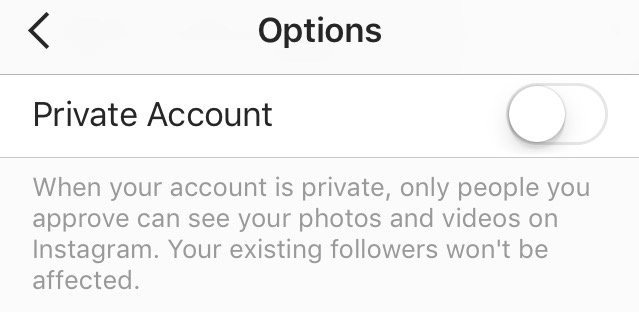
Step 2. Make sure your profile is public. To make your profile public, open Instagram, open "Options," and make sure "Private Account" is turned off.

private.jpg?width=639&name=private.jpg

Step 3. Choose a profile picture that's on-brand with your other social networks, like your company logo.

Step 4. Fill your bio with delightful, actionable, and informative information about your brand. Information like this lets people know what you're about and gives them a reason to follow you. Include who you are and what you do, and be sure to add a hint of personality. Here are a few examples for inspiration:

@WeWork: "Make a life, not just a living." @Oreo: "See the world through our OREO Wonderfilled lens." @CalifiaFarms: "Crafting, concocting and cold-brewing up a delicious, plant-based future." @Staples: "We make it easy to #MakeMoreHappen"

Step 5. Add a link to your bio to make it easy for people to go straight from Instagram to your website if they want to. The space allotted for URLs is precious real estate. When you receive 10,000 followers, you can add swipe up links to your Instagram Stories. Until then, your bio is the only place within Instagram where you can place a clickable link, so use it wisely. We recommend using a shortened, customized Bitly link to make it more clickable.

Step 6. Finally, enable notifications so you can see when people share or comment on your photos. This'll let you engage with them more quickly — just like a lot of companies do on Twitter. To enable notifications, go to "Options" and then "Push Notification Settings." Select "From Everyone" for every category.

A word to the wise: We don't recommend you link your Instagram account to Twitter and Facebook so your Instagram posts are automatically published on those other accounts. Post types are different.

2. Designate a content creator.

Just like there should be one (maybe two) people managing your other social media accounts, there should only be one or two people managing your Instagram account. If possible, choose someone who has experience using a personal Instagram account, and therefore "gets" the platform — and be sure they know all the handy features Instagram has to offer.

If you work for a large organization, you might find that a lot of people want to have a say in what's posted. That's when an organized request or guidelines document comes in hand. This document should inform people how to request a post on your Instagram account, when, the value of the post, and why.

3. Follow photography and editing best practices.

On Instagram, post quality matters. A lot. Your Twitter followers might forgive a few bad tweets, but a bad photo on Instagram is a big no-no. By no means do you have to take a photography course to be a good Instagram poster — nor do you have to practice for weeks before you start. But you should get familiar with basic photography tips and photo editing apps.

Photography Best Practices

Since Instagram is a mobile app, chances are, most of the photos you post to Instagram will be taken on your mobile device. That's not just okay; it's expected. While some brands use professional photography for their Instagram photos, most use smartphones — and that's the vibe that Instagram is meant for, anyway.

Here are some highlights:

Focus on one subject at a time. Embrace negative space. Find interesting perspectives. Look for symmetry. Capture small details. Make your followers laugh. Edit photos before you post.

Instagram has some basic editing capabilities, but oftentimes, they aren't adequate to make a picture really, really great. Most of your photos should go through at least one or two other photo editing apps on your mobile phone before you open them in Instagram for the first time.

4. Set a regular posting schedule.

Once you've created and optimized your profile, have someone manning it, and know a thing or two about phone photography and photo editing, it's time to start posting.

It's a good idea to have a solid number of great posts up — maybe 15 or so — before you start really engaging people and working down this list. That way, when people visit your profile, they'll see a full screen of photos instead of just a handful, so they know you'll be posting great content regularly.

To start posting on Instagram, first download this social media content calendar template and start planning out your Instagram posts. Over time, you'll want to build up a backlog of photos for times of need, like the weekends or when you go on vacation.

Keep your target persona in mind when you first start planning out your posting schedule, as that can drastically change your posting timing and frequency — especially if you're targeting an audience in a different time zone. (Download this free template for creating buyer personas if you don't have a few already.)

Optimizing your schedule for your specific audience might take time and experimentation.

Here are a few of our best practices:

The very best times to post on Instagram seem to be Mondays and Thursdays at any time except between 3:00–4:00 p.m. in the time zone of your target persona. (For a United States audience, your best bet is to combine Eastern and Central time zones, For audiences located outside the U.S., use whichever time zones your target audience uses.) Posting at 5:00 a.m. CDT from Tuesday to Friday generates some of the highest engagement. This is because people tend to check their phones when they wake up. If you post on weekends, try to do so around 11:00 a.m, CDT on Saturday.

Because Instagram is primarily an app for use on mobile devices, users tend to use the network all the time, any time. According to a recent Pew Research study, a majority of U.S. Instagram users are on the app daily, although many users engage with content more during off-work hours than during the workday.  

Some businesses have also seen success with posting at 2:00 a.m., 5:00 p.m., and Wednesdays at 7:00 p.m. Experiment with these to see if they work with your audience.

5. Curate some of your content.

Although it's best to have only one or two people manning your account, one or two people can't be everywhere at once taking photos. What about that fun sushi night the engineers had last night? Or the event your head of sales spoke at earlier this week?

There's a whole breadth of content you'll want to post to Instagram, and more often than not, one person won't be able to keep track of it all.

One solution? Create a system where you can curate photos and content from members of your team. There are a few ways to do this. One is to create a specific email address for employees to send their photos, short videos, memes, hyperlapses, and so on.

Just encourage people to put a subject line on these emails so you can more easily sort through the photos they're sending. While this doesn't seem like the smoothest way to curate photos, it's actually the easiest for the people sending you photos — and the easier you can make it for them to send content, the more content you'll get.

If your team shares a Box or Dropbox account, you could also create a shared folder where people can automatically drop their photos and videos. This just makes a few more steps for the people sending you the content, and not everyone might have that app downloaded on their phones. 

6. Use a consistent, platform-specific brand voice.

Photos and videos might be the most important part of your Instagram posts, but captions, comments, and other text should never be an afterthought. If you're managing a channel for a brand or have more than one Instagram manager, consider developing a consistent voice that humanizes your brand.

This shows potential followers that you are credible and relatable, rather than formal or intimidating. 

When developing a voice, you should keep the platform and your audience in mind. For example, many influencers and prominent accounts on Instagram have a very casual voice and style, but still remain professional and on-brand. Once you've got your voice down, make sure it stays consistent and natural in your captions, comments, messages and your bio. 

7. Write engaging, shareable captions.

Captions are an essential part of your post — the icing on the cake, if you will. Consistently great captions can do wonders for humanizing your brand, winning over followers, and making your content more shareable — thereby giving you more exposure.

Here are a few things you might see in a winning Instagram caption:

Clever or Witty Comments Calls to Action Relevant Emojis Hashtags


Clever or Witty Comments

Some brands and influencers have used clever or witty captions, or even audience-appropriate jokes to further humanize themselves on Instagram.

My colleague Kelly Hendrickson, HubSpot's Social Media Manager, says that she loves Netflix's account and sub-accounts, particularly because of the post captions: "They have such a clear brand voice, and you laugh along with them. They’re in on the joke, just like one of your friends."

Here's one example she gave where Netflix makes a pun out of the term "ghosting":

      View this post on Instagram    

FACT: Casper (1995) is the first recorded incident of what we in 2019 call “ghosting.”

A post shared by Netflix US (@netflix) on May 11, 2019 at 7:23am PDT

Netflix's voice is casual, trendy, and humorous while still staying on brand. In the post above, the caption cleverly connects a new commonly used phrase to an older film that's streaming on the platform.

Calls to Action

Another way to increase the shareability of your caption and engage your followers is to ask questions or have some sort of call-to-action in the captions of your photos. For example, you might say, "Double-tap if you find this funny," or "Share your story in the comments." In the example below, we asked followers of the @HubSpot Instagram account to like the image if they agreed with its advice.  

  Relevant Emojis

According to a recent study, certain emojis can actually spike engagement such as likes, comments, and shares on platforms including Instagram.

Adding just a few relevant emojis can add even more personality to your posts. It could also make them even more noticeable on an Instagram feed. In the post below, HubSpot includes the combination of a call to action and relevant emojis to make the post pop. 


Along with the three items listed above, you'll also want to include hashtags.

8. Optimize posts with relevant hashtags.

On Instagram, a hashtag ties the conversations of different users who wouldn't already be connected into a single stream. If you use relevant hashtags, your posts will get exposure to a wider audience than the people who already follow you or know about your brand.

The key to using hashtags effectively is to use them smartly and sparingly. Try to limit the number of hashtags per caption to around three. Similarly, don't use "like for like" hashtags, like #like4like or #like4likes. This is a dirty tactic that'll leave you with a whole bunch of low-quality followers.

To find the hashtags your audience might be using, do a little research on relevant hashtags in your niche or industry. The easiest way to do this research is in the Instagram app itself, in the "explore" tab (i.e. the magnifying glass icon).

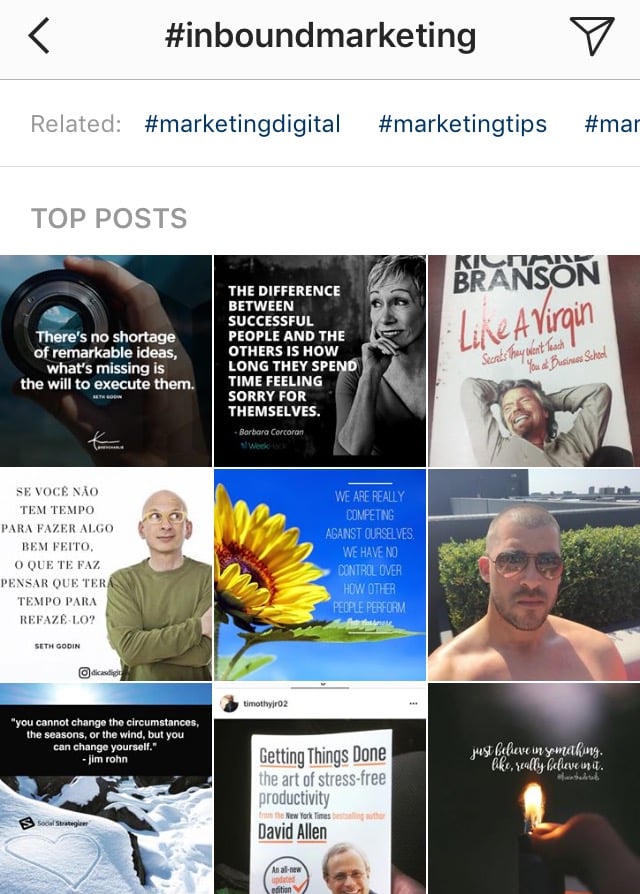
When you search for one hashtag, it'll show you a list of related hashtags at the top of your screen. For example, when I search for #inboundmarketing on Instagram, it shows me relevant hashtags like #marketingdigital, #marketingtips, and so on.

explore.jpg?width=640&name=explore.jpg

To help relate to your followers on a personal level, you might consider hopping on hashtag trends like #tbt ("Throwback Thursday"), #MotivationMonday, #TransformationTuesday, or hashtags that are trending at any given time. 

Here's a post from @HubSpot's account using the #InternationalWomensDay hashtag: Once you build up a bit of a following, you can try creating your own hashtags — like your company name or a slogan that applies to a lot of your photos. This is a great way to build up your brand on the platform and build a more cohesive presence.

  9. Interact with users through follows, likes, and comments.

Instagram is very much a community, and one great way to get involved in that community is to find people who post pictures that interest you, and follow their accounts and interact with their content. It's the most natural way to draw attention to your own Instagram account. It may also get your foot in the door in the platform's community.

That does two things for you: for one, when they get the notification that you've followed them, they might check out your account and decide whether or not to follow you. (This is why it's important to have some great content on there before you start reaching out to others.)

Secondly, it means you'll be seeing their recent posts in your feed, so you can Like and interact with them if you choose to.

As you build a following, celebrate your followers and show you appreciate them by responding to their comments, and even following them and engaging with their posts.

10. Cross-promote with users who have audiences similar to your own.

Once you build a solid relationship with some of the folks behind these accounts that have a similar audience to your own, you might ask to do some co-promotion on each others' accounts.

The more natural and less spammy you can make the content of these cross-promotions — especially the captions — the better. It also helps to be picky about them, and don't do them very often.

Below, @flow, an alkaline water company, and @completelymomblog, the account of a blogger named Cortney Lynn, cross-promoted each other at about the same time:


11. Run Instagram contests to encourage engagement.

Another great way to expand your reach while increasing engagement on your photos is to publish a post promoting a contest, and then ask people to follow your account and Like or comment on the photo in order to enter.

You might add a UGC (User-Generated Content) element to the contest, too, where people post a photo of their own and use a specific hashtag along with following your account. Here's an example of a post from Starbucks promoting a UGC contest on their Instagram account.

  12. Use Instagram Stories and explore its interactive features.

Instagram has always offered the opportunity to post beautiful, curated photos to represent your brand. However, with the introduction of ephemeral Instagram Stories, brands can also share on-the-fly, behind-the-scenes looks for 24 hours that may not be as polished as a published photo, but give your brand more personality on the platform.

One look at Snapchat's explosion in popularity demonstrates that social media users are clearly responding positively to ephemeral photo and video sharing. Instagram Stories let brands engage with users in different ways to cultivate brand loyalty and appeal.

Although Snapchat pioneered this feature, Instagram Stories now has over 400 million daily users, which is double the amount of Snap's user base.

Along with sharing video clips and static images through Instagram Stories, users can also use interactive features like polls to gain more engagement and learn more about their Instagram audiences. Once a user is verified or has over 10,000 followers, they can even include a link to a webpage within a story.

How Brands Can Use Instagram Stories

Instagram Stories disappear after 24 hours, unless they are marked as a "Featured Story." Featured stories will show up at the top of your profile between the photo feed and your bio. We can't embed Instagram Stories just yet, but you can view HubSpot's Instagram page to see what we've featured.

Here are a few other brands we recommend following to see what they're sharing:

Rachel Brathen (@yoga_girl) is a yoga teacher and entrepreneur in Aruba who uses Instagram Stories to document the behind-the-scenes action of building a yoga studio. While her Instagram portfolio features beautiful, professional photos and videos of her in yoga poses, her Stories feature her dog sitting in on staff meetings, her team unwrapping amethyst crystals to decorate her studio, and artists painting the walls.

She uses Stories to showcase the other side of her brand to her 2 million followers in an authentic and unpolished way, and to keep her followers apprised of what she does every day (besides yoga, of course).

Dana Shultz (@miniamlistbaker) publishes easy vegan and gluten-free recipes on her blog. Her Stories feature neat how-to videos of her making breakfast and testing out new recipes in her kitchen. The behind-the-scenes aspect of her Stories provide a lot of human context for her blog's brand, and everybody loves a good how-to video.

Casper (@casper) publishes quirky Instagram content to advertise their mattresses -- without overtly doing so. The main theme of their content? Staying in is better than going out (because you can stay in and lay on a comfy Casper mattress, naturally).

They've even created a gallery for followers to use as backdrops for their Snapchat and Instagram stories to make it look like they're out at a party, when they're really laying in bed. One of their latest Instagram Stories featured someone watching "The Sopranos" in bed, with the caption: "Who needs plans when you have five more seasons?" This video supports Casper's campaign to stay in bed with a very real look at what millions of people do when they're hanging out at home.

Here are our tips for using Instagram Stories for your brand:

Whether it's funny, sad, or unique, be authentic. Your photo gallery is where content can be perfect and polished. Instagram Stories are for the raw, unscripted, and un-retouched. Use Stories to share the other side of your brand that followers might not be able to glean elsewhere. Do you have a dog-friendly office? Is your team trying out the Mannequin Challenge? Start filming to showcase the more human side of your brand. Go behind-the-scenes. These are by far our favorite type of content for ephemeral video sharing. Show followers what goes into the planning of an event or the launching of a product, and make it fun. Your followers want to feel included and in-the-know, and you could use Stories to cultivate a brand loyalty program that only rewards people who check out your content. Embrace interactivity. As mentioned above, Instagram allows you to add interactive stickers to your stories. For example, you can ask your audience to vote in a poll, rate something on a sliding scale, or send you burning questions. These features might help you learn about your audience while also engaging with them. 13. Use the Live Video feature.

Instagram also lets users record and share live videos, another content format that's proven to be hugely popular on other social networks. What's unique about live videos on Instagram? They disappear when users stop filming.

This authentic, bi-directional experience lets brands share unscripted, raw moments with their audience to incorporate human elements into a social media platform that's highly edited and polished in its traditional use.

Since the Live feature launched, Instagram has added even more features that may enable more engagement or interactions from viewers. For example, users can now launch live video Q&As or add music to live streams.

Live video is a growing trend across a variety of social media platforms, so if something interesting is happening, start rolling. Whether it's a team birthday party, a staff meeting, or a cute animal, your devoted followers want to see what you're up to every day.  14. Share your profile link on your website and social media channels.

Place a follow button on your homepage, your "About Us" page, and various other places on your website. Consider adding an Instagram badge to your website that hyperlinks to your account. Here's what the badge could look like:

ig-badge-view-24.png

If your brand has brick-and-mortar locations, put out a good ol' print call-to-action letting people know you have an Instagram account and encouraging them to follow you.

Also, be sure to promote your Instagram account on your other social media accounts. Chances are, the folks who already follow you on Facebook and Twitter will also follow you on Instagram without much prodding. Let those followers know you're on Instagram and encourage them to follow you there by including a link to your Instagram account in the bios and posts of those other social media accounts.

So give it a shot: Make a profile and start posting, testing, tweaking, and promoting your account. Garnering a following on Instagram won't happen overnight, but the stronger of a foundation you create on your account in in your niche Instagram community, the higher quality your followers will be.

15. Apply for a verification badge.

When an account on Instagram is verified, it has a blue dot, called a badge, next to the username. When another user comes across this profile or finds the verified username in search, the blue dot confirms to them that the account is the business, individual, or brand that it's claiming to be. 

While Instagram has a list of eligibility requirements for the badge, the platform does allow users to apply for one. You can learn more about that process in Instagram's help center. 

5848cf64-d1ce-4245-8440-eaffd08f875a.png __ptq.gif?a=53&k=14&r=https%3A%2F%2Fblog.hubspot.com%2Fmarketing%2Fgain-instagram-followers&bu=https%253A%252F%252Fblog.hubspot.com%252Fmarketing&bvt=rss

Read more: blog.hubspot.com

https://infoforu.org/15-ways-to-get-more-followers-on-instagram/

Sunday, October 28, 2018

How You Can Increase Sales by 30% on Black Friday

black-friday-sales-header.jpg

Black Friday is coming up fast. Are you ready for it?

This article will get you where you need to be.

I’ll be giving you the strategies we’ve used with clients to drive 30% increases in Black Friday sales.

This is some “behind-the-curtain” stuff which may or may not get me fired.

Let’s get rolling nonetheless, and if the article cuts off somewhere in the next 1200 words, you’ll know I’ve been sacked.

Drive traffic with social media and advertising

The first thing is to get your brand out there and get it seen by prospective customers.

The easiest way to do that is through social media and advertising.

This section will cover promoting your brand on Facebook, with Facebook Ads, and with Google Ads.

Create your social media posts

You should start promoting your Black Friday deals at least a week before the day itself.

Remember that people consider the week around Thanksgiving as a bit of a holiday, so social media usage tends to drop off. As a result, be sure you get your posts in under the wire before people start travelling.

Here’s a good idea of social media usage around the Holidays:

social-media-usage.jpg

What you’re seeing there is Thanksgiving in the bottom quartile beneath the average, and the weeks before in the second quartile above it.

Here’s a Black Friday post example from Home Depot:

home-depot-black-friday-post.png

What I like about this post:

Focusing on the products, and making them look good Focusing on Holiday products – things you need to buy as gifts or for the holiday season “Lowest Prices of the Year” implies that, if you miss out on these prices, you’ll have to pay more later Big, clear font Related Reading

For a guide to holiday social media, check out “7 Social Media Hacks for the Holiday Season.”

Create your Facebook Ads

Before we dive into online advertising, there’s something you should be aware of:

Ads cost about twice as much between the third week of November and the New Year as they do the rest of the year.

The graph looks, depressingly, like this.

black-friday-ad-costs.png

So, there’s a strategy we use to maximize our client’s ad budget…

Bonus Tip: Creating Early-access Campaigns.

These campaigns, promoted with online ads *in the weeks before Black Friday*, give people access to your deals 24 hours before anyone else.

As the president of Savings.com says, “If you’re going to buy a big-screen TV, you’re only going to buy one, so whoever gets it first wins.”

Equally, whoever sells it first wins.

So don’t get persnickety about the day itself. Instead, create a campaign page to collect prospective customers interested in saving big before anybody else.

Here’s an example from last year, from our client JustLive:

black-friday-early-access-contest.png

Then, create an email drip campaign which is sent to all your entrants giving them access to exclusive Black Friday deals 24-hours before you open those deals to the public. This exclusivity is also effective in ramping up conversion rates.

Okay, back to the article.

If you decide to do Facebook Ads around Black Friday, be sure you get them right.

Here are a few Black Friday Facebook Ad examples from businesses like yours from last year:

black-friday-facebook-ad-example-5.pngblack-friday-facebook-ad-example.pngblack-friday-facebook-ad-example-4.pngblack-friday-facebook-ad-example-3.pngblack-friday-facebook-ad-example-2.png

Advertising platform AdEspresso has a really good, searchable library of Facebook Ads. If you’re looking for inspiration for your Black Friday ad, I recommend you check them out (after finishing this post, of course).

Equally, if you do decide to run Google Ads, do them right as well.

A few Black Friday Google Advertising best practices:

Reference “Black Friday” in the ad copy itself. It’ll grab the eye of searchers Put the time limit right into the ad. For instance, “Sale Ends in 5 Hours.” Then update the ad throughout the day. Include the inventory limitations throughout the day. For instance, “Only 14 left at this price” right within the ad.

For example:

black-friday-google-adwords-example.png

black-friday-google-adwords-example-2.png

Reminder:

Google determines the cost of a click based on traffic for the search term. Around Black Friday, search traffic is going to explode. As a result, you need to increase your ad budget, significantly, to be seen at all. For instance, searches for toys go up 50% around Black Friday. Budget accordingly.

This is especially true if you’re targeting a keyword with “deal” in it:

black-friday-traffic-2.png

Update your website to drive people to your Black Friday sales

On the day itself, my recommendation is to have your website visitors avoid your homepage entirely.

You’ll drive more sales if you point people in the direction of A) a page specific to the ad they clicked on, or B) an experience oriented around the discounts you’re offering.

So instead of directing people to your homepage, create a redirect towards a Black Friday-oriented product directory, and exclusively drive people there for the duration of the promotional season.

For instance, this example from Home Depot:

homedepot-black-friday-landing-page.png

Not sure how to create a redirect?

There are a few options, depending on what platform your website is built upon. Check out this guide for WordPress, and this Google search for everything else.

Next, create department-based, Black Friday landing pages, like this one:

home-depot-landing-page-2.png

What I like about this page:

Countdown timer adds urgency to the buying experience Discounts are in orange and clearly visible “Today only” also adds urgency Clearly displays how much the products are normally, without discount


Use popups to turn traffic into leads, if not customers

Popups, though controversial, are an awesome way for you to notify Black Friday traffic about your deals, as well as turn them into leads.

A simple entry popup to make every website visitor aware of your deals:

black-friday-popup-example-1.png

An entry popup offering a bonus promotion exclusively available to subscribers:

black-friday-popup-example-2.png

Top Tip:

I recommend you focus on turning Black Friday traffic into subscribers, either through the “Early-Access” campaign I showed you above, or through popups like this one. 90% of your website traffic isn’t going to complete a purchase the first time, but with email campaigns (especially abandoned cart emails), you have a chance to convert them down the line.

Final Thoughts

The Black Friday period (the weeks surrounding the big day) is the biggest consumer time of the year.

Online traffic is high. Competition is fierce. You need to stand out and make sure your website is ready for what’s the come.

If you have any questions about anything you’ve read in this post, don’t hesitate to reach out in the comment section below.

I hope you have a huge holiday season!

Q294v-Y0ChA

Read more: feedproxy.google.com

https://bluetoothproximitymarketing.info/how-you-can-increase-sales-by-30-on-black-friday/